
How Many Classes Can You Skip? Calculating Permissible Absences with Ease
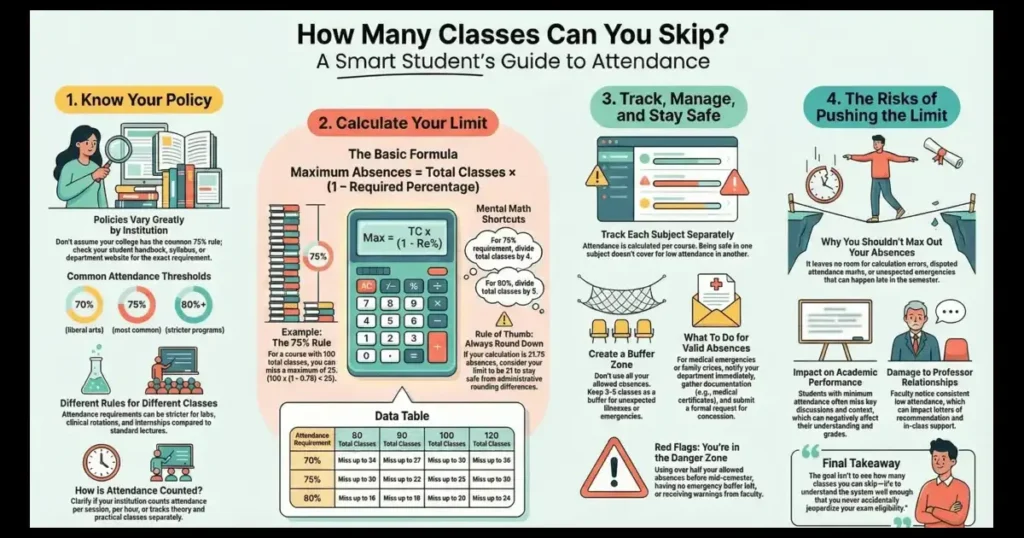
Table of Contents
How Many Classes Can You Skip?
One of the most common questions students ask themselves each semester is: “How many classes can I actually miss without getting into trouble?” It’s a practical concern that affects your daily decisions, especially when you’re juggling multiple responsibilities, dealing with health issues, or simply need a mental health day.
The answer isn’t just about gaming the system—it’s about understanding your institution’s policies and making informed choices that protect your academic standing while maintaining a healthy balance.
Let’s walk through the math, the rules, and the smart strategies for managing your class absences.
DOWNLOAD OUR PDF ON: Attendance Strategy Management pdf
Understanding Your Institution’s Attendance Policy
Before calculating anything, you need to know the specific attendance requirements at your college or university. While the 75% attendance rule is common in many institutions, policies can vary significantly.
Common attendance thresholds include:
- 75% minimum attendance (most Indian universities and technical institutions)
- 80% attendance requirement (some stricter programs)
- 70% minimum (certain liberal arts colleges)
- No fixed percentage but participation-based grading
- Different percentages for lectures versus lab sessions
Check your student handbook, course syllabus, or department website for the exact requirement. Some institutions even have different attendance policies for different types of courses—theory classes might have one standard while practical or laboratory sessions have stricter requirements.
Don’t assume the rules are the same as your friend’s college or your sibling’s university. Policies differ, and your academic eligibility depends on following your specific institution’s guidelines.
The Basic Calculation Formula
Once you know your required attendance percentage, the calculation becomes straightforward. Here’s the fundamental formula you’ll use:
Maximum Absences = Total Classes × (1 – Required Percentage)
Let’s break this down with a real example. Suppose you’re enrolled in a course with 100 scheduled classes and your college requires 75% attendance:
Maximum Absences = 100 × (1 – 0.75) = 100 × 0.25 = 25 classes
This means you can miss up to 25 classes and still meet the minimum requirement.
Alternatively, you can think of it this way:
Required Attendance = Total Classes × Required Percentage
Using the same example: 100 × 0.75 = 75 classes you must attend
Subtract this from the total: 100 – 75 = 25 classes you can miss
Both methods give you the same answer. Use whichever feels more intuitive to you.
Calculating for Different Attendance Requirements
Let’s look at how the numbers change with different policies and class totals.
For 75% attendance requirement:
- 80 total classes → can miss 20 classes
- 90 total classes → can miss 22-23 classes
- 100 total classes → can miss 25 classes
- 120 total classes → can miss 30 classes
For 80% attendance requirement:
- 80 total classes → can miss 16 classes
- 90 total classes → can miss 18 classes
- 100 total classes → can miss 20 classes
- 120 total classes → can miss 24 classes
For 70% attendance requirement:
- 80 total classes → can miss 24 classes
- 90 total classes → can miss 27 classes
- 100 total classes → can miss 30 classes
- 120 total classes → can miss 36 classes
Notice how significantly the numbers change based on the required percentage. An 80% requirement is considerably stricter than a 75% one, giving you much less flexibility.
Dealing with Partial Numbers
In reality, you’ll rarely have perfectly round numbers. A semester might have 87 classes scheduled, or 93, or any other figure. When your calculation results in a decimal, always round down to stay safe.
For example, with 87 total classes and a 75% requirement:
87 × 0.25 = 21.75
You should consider your limit as 21 classes, not 22. Why? Because rounding up could push you below the required percentage if attendance is calculated differently by your college administration.
Here’s a quick reference table for 75% attendance with various class totals:
- 85 classes → miss maximum 21 (not 21.25)
- 92 classes → miss maximum 23 (not 23.00)
- 78 classes → miss maximum 19 (not 19.5)
- 105 classes → miss maximum 26 (not 26.25)
Being conservative protects you from calculation errors, rounding differences in the college system, or any disputed attendance marks.
Creating Your Personal Attendance Tracker
Simply knowing how many classes you can miss isn’t enough. You need a system to track your attendance throughout the semester.
Set up a simple tracking system:
Week-by-week log: Create a spreadsheet or use a notebook to mark present/absent for each class. Include the date, subject, and whether you attended.
Running totals: Calculate your current attendance percentage regularly, not just when you think you’re cutting it close.
Buffer zone: Don’t use up all your permitted absences. Keep at least 3-5 classes as a buffer for genuine emergencies like sudden illness or family situations.
Subject-wise tracking: Remember, attendance is usually calculated separately for each course. You might have good attendance in one subject but be dangerously low in another.
Many students make the mistake of thinking about their overall attendance across all subjects. That’s not how it works. You need 75% (or whatever your requirement is) in each individual course.
Understanding How Attendance Is Actually Counted
The way your institution counts attendance can significantly affect your calculations.
Different counting methods include:
Per-session counting: Each class session counts as one unit, regardless of duration. A one-hour lecture and a three-hour lab might both count as single sessions.
Per-hour counting: Some institutions count attendance by contact hours. A three-hour session counts as three attendance units.
Separate lab and theory: Practical and theory classes might be tracked independently, even for the same course. You might need 75% in lectures AND 75% in labs separately.
Tutorial sessions: Small group tutorials or discussion sections may or may not count toward your attendance, depending on institutional policy.
Make-up classes: Extra classes scheduled to cover holidays or missed content might not always count toward total classes, or they might—policies vary.
Ask your professors or check with the academic office about exactly how attendance is recorded in your program. This information directly affects your calculations.
The Reality Check: Why You Shouldn’t Max Out Your Absences
Mathematically, you might be able to miss 25 classes out of 100. But should you? Here’s why treating your maximum as a target is risky:
Calculation errors: You might miscount, or the college system might record attendance differently than you expected.
Disputed attendance: Sometimes you’re marked absent when you actually attended. Resolving these disputes takes time, and meanwhile, your percentage drops.
Unexpected emergencies: Life happens. You might get sick, have a family emergency, or face unexpected situations. If you’ve already used all your permitted absences, you’re in trouble.
Academic impact: Students with bare minimum attendance often struggle academically. You miss important discussions, clarifications, and context that helps you understand material deeply.
Professor relationships: Faculty notice students who consistently hover at minimum attendance. This can affect your recommendations, project guidance, and even your grades if participation is factored in.
Professional habit formation: University isn’t just about passing exams. It’s about developing habits that serve you in your career, where consistent presence matters.
Smart students use the 80-20 approach: if you can miss 25 classes, aim to miss no more than 15-20, keeping 5-10 as emergency buffer.
When Absences Are Beyond Your Control
Sometimes missing classes isn’t a choice. Understanding how to handle these situations protects your academic standing.
Valid reasons for absence typically include:
- Medical emergencies requiring hospitalization or extended treatment
- Serious illness with proper medical documentation
- Death or critical illness of immediate family members
- Representing your institution in official competitions or events
- Natural disasters or situations beyond personal control
- Mandatory legal obligations like court appearances
For these situations, don’t just skip class and hope for the best. Follow proper procedure:
- Notify immediately: Inform your professor and department as soon as possible, even if it’s via email or through a classmate.
- Gather documentation: Collect medical certificates, official letters, or any proof of your situation.
- Submit formal requests: File for attendance concession or medical leave through proper channels.
- Follow up: Ensure your application is processed before the exam eligibility deadline.
Remember that even with valid reasons, approval isn’t automatic. Some institutions have limits on medical concessions or require committee approval for attendance exemptions.
Special Considerations for Different Course Types
Not all classes are created equal when it comes to attendance calculations.
Laboratory sessions: These usually have stricter attendance requirements—often 80% or even 90%—because hands-on practical experience cannot be replicated through reading or notes.
Clinical rotations: Medical, nursing, and health sciences students face extremely strict attendance policies for clinical work, often allowing zero room for absence without make-up sessions.
Fieldwork and internships: Courses involving external placements typically count every single day, as you’re representing your institution in professional settings.
Online or hybrid courses: With the rise of digital learning, attendance might be tracked through login times, assignment submissions, or participation in discussion forums. Understand how “attendance” is defined in these formats.
Block or intensive courses: Short-term courses compressed into a few weeks might count attendance differently, sometimes requiring 100% presence for such condensed formats.
Always check the specific requirements for each type of class you’re enrolled in.
Quick Calculation Tools and Tricks
For those who want faster ways to calculate their permissible absences, here are some mental math shortcuts:
For 75% requirement: Divide total classes by 4. That’s your maximum absences.
- 80 classes ÷ 4 = 20 absences
- 100 classes ÷ 4 = 25 absences
For 80% requirement: Divide total classes by 5. That’s your maximum absences.
- 100 classes ÷ 5 = 20 absences
- 80 classes ÷ 5 = 16 absences
For 70% requirement: Multiply total classes by 0.3 (slightly less than one-third).
- 90 classes × 0.3 = 27 absences
You can also use percentage calculators available on smartphones or create a simple Excel formula:
=ROUNDDOWN(Total_Classes*(1-Required_Percentage),0)
Save this formula in your phone’s calculator app or notes for quick reference throughout the semester.
Red Flags: Signs You’re in the Danger Zone
Watch for these warning signs that indicate you’re risking exam ineligibility:
- You’ve missed more than half your permitted absences before mid-semester
- You’re avoiding calculating your actual attendance percentage
- You’re missing classes in multiple subjects, not just one
- You’re relying on “I think I’m okay” rather than actual numbers
- You have no emergency buffer left for unexpected situations
- Faculty members have warned you about your attendance
- You’re considering skipping class to prepare for an exam (ironic, since poor attendance might prevent you from taking that exam)
If any of these apply to you, it’s time to tighten up your attendance immediately. Every class you attend from this point forward improves your position.
Key Takeaways
Understanding how to calculate permissible absences empowers you to make informed decisions about your academic attendance. Here’s what you need to remember:
- Know your policy: Confirm your institution’s exact attendance requirement—don’t assume it’s the same as other colleges
- Calculate conservatively: Use the Attendance formula (Total Classes × (1 – Required Percentage)) and always round down
- Track consistently: Maintain a subject-wise attendance log throughout the semester, not just when you’re worried
- Keep a buffer: Never use all your permitted absences—save 20-25% of them for genuine emergencies
- Count correctly: Understand whether your institution counts by session, by hour, or uses different rules for different class types
- Document absences: When you must miss class for valid reasons, gather proper documentation immediately
- Act early: If you’re falling short, apply for concessions or address the issue before the exam eligibility deadline
The goal isn’t to see how many classes you can skip—it’s to understand the system well enough that you never accidentally jeopardize your exam eligibility. Use your permitted absences wisely, maintain a safety margin, and prioritize consistent attendance for both your academic success and professional development.
Your presence in class is an investment in your education. Calculate smartly, attend diligently, and protect your academic future.