
Table of Contents
75% Attendance Rule Explained
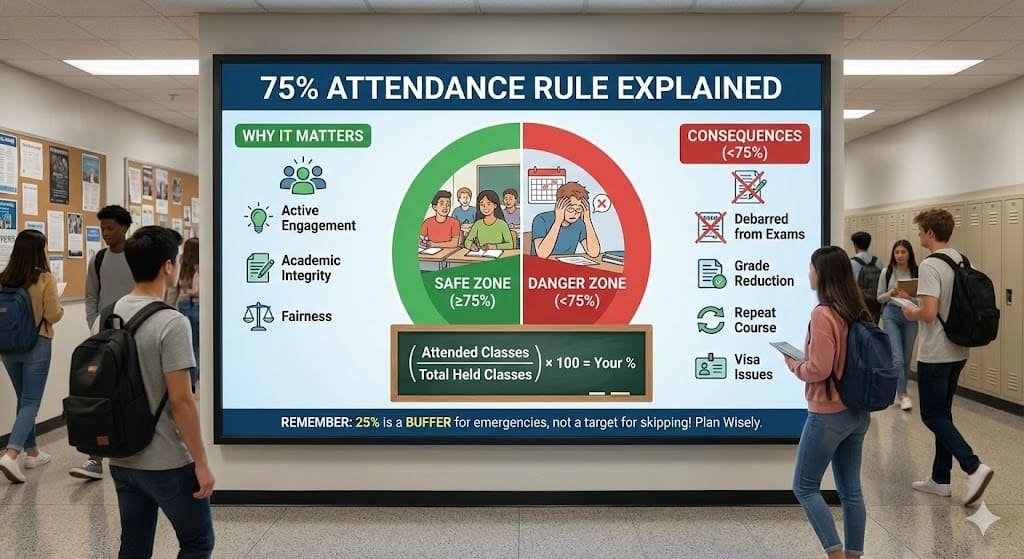
How Many Classes Can I Miss for 75% Attendance? The 75% attendance rule means you must attend at least three out of every four classes conducted during the semester. This is one of the most commonly followed requirements across colleges and universities for maintaining academic eligibility.
Many colleges use 75% as a standard benchmark because it balances academic discipline with reasonable flexibility for students. It ensures regular class participation while allowing room for occasional absences due to illness, emergencies, or personal commitments.
Failing to meet 75% attendance typically affects your ability to appear in semester exams, impacts internal assessment marks, and may result in academic warnings. Some institutions also link attendance to scholarship eligibility, placement participation, and course completion certificates.
The requirement applies to individual courses or subjects. If you’re enrolled in five subjects, you need 75% attendance in each one separately, not just an overall average across all courses.
How to Calculate Allowed Absences for 75%
To calculate how many classes you can miss and still maintain 75% attendance, you need two pieces of information: the total number of classes conducted and the minimum number you must attend.
The basic formula works like this:
Minimum classes to attend = Total classes × 0.75
Maximum classes you can miss = Total classes – Minimum classes to attend
Example calculation:
Let’s say 60 classes will be conducted in your course by the end of the semester.
- Minimum you must attend: 60 × 0.75 = 45 classes
- Maximum allowed absences: 60 – 45 = 15 classes
This means out of 60 classes, you can miss up to 15 and still meet the 75% attendance requirement.
Working backwards from current attendance:
If classes are already underway, calculate differently:
- Total classes so far: 40
- You’ve attended: 35
- Current percentage: (35 ÷ 40) × 100 = 87.5%
- Minimum needed: 40 × 0.75 = 30
- Your buffer: 35 – 30 = 5 classes
You can miss 5 more before reaching the threshold, assuming no additional classes are scheduled.
Important note: The total number of classes often increases as the semester progresses. Professors add makeup classes, extra lectures, or revision sessions. Recalculate regularly to account for these changes.
Bunk Planner Examples for 75% Attendance
| Total Classes | Attended | Required % | Minimum Needed | Safe Bunks | Current % |
|---|---|---|---|---|---|
| 60 | 45 | 75% | 45 | 0 | 75.0% |
| 60 | 50 | 75% | 45 | 5 | 83.3% |
| 80 | 60 | 75% | 60 | 0 | 75.0% |
| 80 | 68 | 75% | 60 | 8 | 85.0% |
| 40 | 30 | 75% | 30 | 0 | 75.0% |
| 40 | 35 | 75% | 30 | 5 | 87.5% |
| 100 | 75 | 75% | 75 | 0 | 75.0% |
| 100 | 82 | 75% | 75 | 7 | 82.0% |
Understanding the examples:
Let’s break down the second row. If 60 classes have been conducted and you’ve attended 50, your current attendance is 83.3%. For 75% attendance, you only need to have attended 45 classes minimum (60 × 0.75 = 45).
Since you’ve already attended 50 classes, you have 5 extra classes as a buffer. This means you can safely miss up to 5 of the remaining scheduled classes before your attendance drops to exactly 75%.
The “safe bunks” column shows your cushion above the minimum requirement. When this number is 0, you’re at exactly 75% and cannot afford any more absences.
Real-world application:
Students typically aim for 80-85% attendance to maintain a comfortable buffer. This extra 5-10% protects you during emergencies, illness, or unexpected situations later in the semester.
Quick Reference: Classes You Can Miss at 75%
| If Total Classes Are | You Must Attend Minimum | You Can Miss Maximum |
|---|---|---|
| 20 | 15 | 5 |
| 40 | 30 | 10 |
| 60 | 45 | 15 |
| 80 | 60 | 20 |
| 100 | 75 | 25 |
| 120 | 90 | 30 |
This table assumes you’re calculating from the start of the semester. If you’ve already used some absences, subtract those from the “Can Miss” column.
Per week breakdown:
If you have 4 classes per week in a subject:
- Monthly classes: approximately 16
- Maximum monthly absences: 4
- That’s about 1 absence per week on average
Spread across multiple subjects, your available absences accumulate, but so does the risk of falling below the threshold in any single subject.
What Happens If You Go Below 75%?
Falling below 75% attendance triggers several academic consequences, though the severity varies by institution. The most common penalty is being barred from appearing in semester-end examinations for that particular course.
Many colleges issue attendance warnings when you approach the threshold, typically around 76-78%. These warnings give you time to improve attendance before facing serious consequences. Ignoring these warnings and continuing to miss classes usually results in exam ineligibility.
Some institutions allow students below 75% to apply for condonation, which is a formal request to waive the shortage due to medical reasons, family emergencies, or other valid circumstances. This process typically requires documentation and approval from academic authorities.
Additional consequences may include:
- Reduction in internal assessment marks
- Loss of scholarship eligibility
- Inability to participate in placement activities
- Requirement to repeat the course in the next semester
- Academic probation status on your record
- Delays in degree completion
If you’re close to the limit:
Check your official attendance record weekly through your college portal. Don’t rely on manual counts or assumptions. Contact your class advisor or professor immediately if you’re approaching the threshold. Some professors offer makeup assignments or extra sessions to help students recover attendance.
Many students make the mistake of thinking they can attend all remaining classes to compensate. This rarely works because the percentage calculation is cumulative. If you’re at 72% with 80 classes conducted, attending all future classes only slowly pulls your percentage up.
➡️ Use the Safe Bunk Planner to track your attendance and calculate safe absences throughout the semester.
FAQs About 75% Attendance
Do labs count the same as lectures?
Lab attendance usually has separate and stricter requirements. Many colleges mandate 90-100% attendance for laboratory sessions because they involve hands-on learning, equipment usage, and group activities that cannot be made up later. Always check your lab manual or course guidelines, as lab absences often carry heavier consequences than lecture absences.
What if the total number of classes increases later?
This is common and directly impacts your safe bunks. When professors schedule additional classes, your attendance percentage gets recalculated against the new total. If you’ve already used most of your allowed absences and 10 more classes get added, you may suddenly have zero bunks remaining or even fall below 75%. Recalculate every time new classes are announced.
Is 75% attendance strictly enforced?
Enforcement varies by institution. Some colleges strictly bar students from exams with 74.9% attendance, while others may round up to 75% if you’re close. A few institutions allow small grace margins (like 74-74.5%) at the discretion of the department. However, never count on lenient enforcement. Treat 75% as a hard boundary and aim for at least 78-80% to be safe.
Can medical reasons affect the calculation?
Medical absences are typically still counted as absences in the attendance calculation. However, most colleges have a condonation process where you can apply for attendance shortage waiver by submitting medical certificates, hospital documents, or doctor’s notes. This process is separate from the attendance calculator and requires administrative approval. The percentage calculation itself doesn’t automatically exclude medical absences.
Should I recheck my attendance every week?
Yes, absolutely. Check your official attendance portal every Monday or after each week of classes. Attendance records sometimes contain errors, classes get added to the schedule unexpectedly, and your safe buffer changes as the semester progresses. Weekly monitoring prevents unpleasant surprises before exams and gives you time to course-correct if needed.
What’s the difference between 75.0% and 76%?
That 1% difference equals approximately 1 class in every 100 conducted. While both are technically above the threshold, 75.0% means you have zero room for error. One missed class or one wrongly marked absence drops you below. At 76%, you have a small cushion. Most academic advisors recommend maintaining at least 77-78% to account for unexpected situations.
Does attendance reset each semester?
Yes, for semester-based courses. Your attendance percentage starts fresh at the beginning of each new semester. Year-long courses or annual programs may calculate attendance across the full academic year. Summer sessions and special terms have their own separate attendance tracking. Check your academic calendar to understand how your program structures attendance calculation.
Can I carry forward extra attendance to the next semester?
No. Attendance is calculated independently for each semester or term. Having 95% attendance in Semester 1 doesn’t give you extra bunks in Semester 2. Each course starts at 0% attendance when it begins, regardless of your previous record.
Note: This calculator provides estimates based on standard percentage calculations commonly used in educational institutions. Final attendance requirements and eligibility depend on your specific college’s policies, official attendance records, and course regulations. Always verify your attendance status through official channels and consult your academic advisor for guidance on your individual situation.