
Attendance Grace Marks: Are They Allowed?
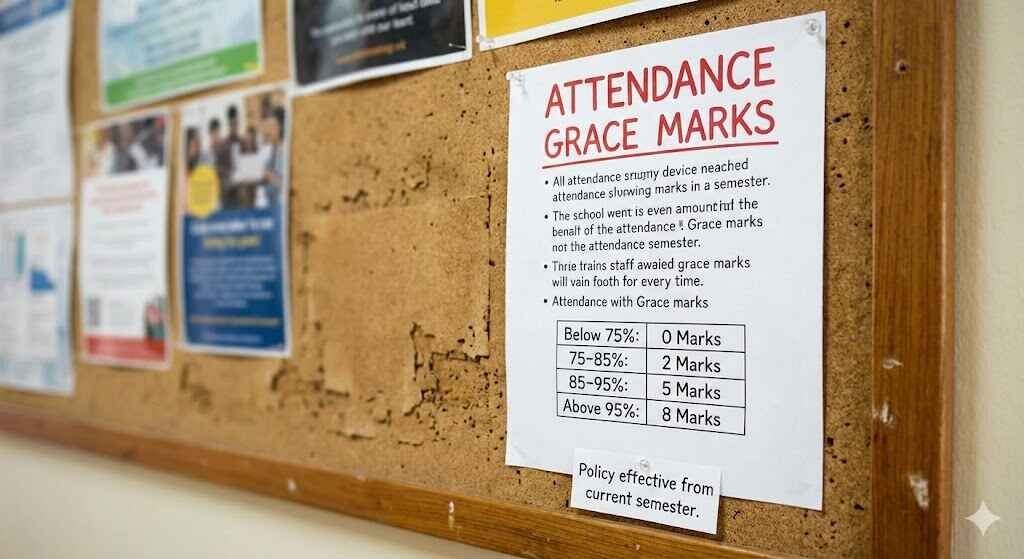
You’re at 73% attendance. Your college requires 75%. You’ve heard rumors about “grace marks” that might save you. But when you ask around, you get different answers from different people.
Let me clear this up once and for all. I’ve worked with multiple colleges, and here’s what actually happens with attendance grace marks versus what students think happens.
Table of Contents
The Truth About Attendance Grace
Most colleges don’t give attendance grace marks the way they give grace marks in exams.
When you score 38/100 on a paper and the college gives 2 grace marks to bump you to 40 (passing), that’s exam grace. It’s common. Most universities allow this.
Attendance grace? Different story.
What colleges actually do is called “relaxation” or “condonation,” not grace marks. The difference matters because students hear “grace” and think it’s automatic. It’s not.
What Relaxation Actually Means
Relaxation means the college officially excuses your attendance shortage under specific conditions. You don’t automatically get 2-3% added to your attendance. Instead, you apply, they review your case, and they decide.
Here’s what this looks like in practice:
You have 72% attendance. The requirement is 75%. You apply for relaxation with a medical certificate showing you were sick for a week. The college reviews it. If approved, they condone (excuse) your shortage and let you take exams despite being at 72%.
You didn’t get “grace marks.” You got conditional approval based on documented reasons.
When Colleges Actually Grant Relaxation
Medical Reasons
This is the most accepted ground. If you were genuinely sick and have proper documentation, colleges usually consider relaxation.
But “proper documentation” means:
- Medical certificate from a registered doctor
- Hospital records if you were admitted
- Prescription or treatment records
- Dates matching your absence period
A generic certificate saying “student was unwell” won’t work. It needs to show what happened, when, and that medical advice required you to stay home.
Most colleges allow medical relaxation up to 5% of total classes. So if the requirement is 75%, they might excuse you down to 70% for medical reasons. Below that, even medical certificates might not help.
Family Emergencies
Death in immediate family, parent’s serious illness, unavoidable family crisis—these qualify if documented.
You’ll need proof. Death certificate, hospital admission papers, whatever shows the emergency was real and required your presence. Vague explanations don’t cut it.
Representing College in Events
If you missed classes because you were representing your college in sports, cultural events, or academic competitions, you’re usually covered.
But this only works if:
- You got prior permission from authorities
- The event was official
- You have documentation (participation certificate, permission letter)
Bunking class to participate in an external event you registered for yourself? That won’t get relaxation.
Official College Activities
Attending seminars, workshops, or training programs organized by your college sometimes counts toward attendance or gets relaxed. Check with your department—policies vary.
When You Won’t Get Relaxation (Even If You Think You Should)
Let’s be clear about situations where colleges won’t grant relaxation:
Job or Internship Commitments
Working during college hours isn’t grounds for relaxation. Neither is doing an internship you chose to take on. Colleges expect you to manage both or pick one.
Exception: If your college itself arranged the internship as part of curriculum, different rules apply.
Personal Travel
Went on a family vacation? Trip with friends? Attending a wedding in another city? None of these get relaxation.
I know students think “but it was my brother’s wedding” sounds important. To the college, it’s still personal choice.
Poor Time Management
Missed classes because you were sleeping, completing assignments, or just didn’t feel like attending? No relaxation.
Even if you explain you were stressed or overwhelmed, without medical documentation of illness, this won’t fly.
Religious or Cultural Events
This is tricky. Some colleges accommodate major religious holidays, especially if you belong to a minority community whose festivals don’t align with college holidays. But casual observances or personal religious trips usually don’t count.
College vs University: Who Decides?
Here’s something most students don’t understand: your college and your university might have different policies.
If you’re in an autonomous college: Your college sets rules and decides on relaxation. The process is usually faster because fewer layers of approval are needed.
If you’re in an affiliated college: Your university sets minimum standards, but your college handles day-to-day attendance. For relaxation, you might need college approval first, then university approval. This takes longer.
For direct university students: University policies apply directly. Usually more rigid because you’re dealing with a larger bureaucracy.
Check your college handbook. It should specify who has authority over attendance relaxation decisions.
Maximum Relaxation You Can Expect
This varies wildly, but here are common patterns:
5% for medical reasons is standard at most places. If the requirement is 75%, you might get relaxed down to 70% with proper medical documentation.
2-3% for other valid reasons like family emergencies, representing college, etc.
No relaxation below 65-70% is common. If you’re sitting at 60% attendance, even with medical certificates, most colleges won’t let you take exams. You’ve missed too much content to realistically pass.
Some colleges are stricter: relaxation only if you’re within 2-3% of the requirement. Others are more lenient, going case-by-case.
The key: Don’t count on relaxation when planning your semester. Aim to meet the requirement normally. Treat relaxation as a backup for genuine emergencies, not a strategy.
Final Year Students: Special Treatment?
Sometimes yes, sometimes no.
Some colleges are more lenient with final year students because:
- You’re close to graduation
- One more semester or year costs everyone time and money
- Your placement might be affected
Other colleges are stricter because:
- You should know better by final year
- They want to enforce discipline before you graduate
- Professional courses have stricter accreditation requirements
If you’re in final year with attendance issues, mention:
- Your overall academic record if it’s strong
- Any placements or job offers that depend on graduating on time
- This being your last chance before graduation
It might help. No guarantees.
The Application Process
If you think you qualify for relaxation, here’s how to apply:
Write a formal application to your Head of Department or Principal. Keep it short:
Subject: Request for Attendance Relaxation
Respected Sir/Madam,
I am [Name], Roll No. [Number], [Year/Semester]. My current attendance is [X]% due to [specific reason: medical treatment/family emergency]. I have attached supporting documents.
I request attendance relaxation to allow me to appear for semester exams.
Thank you,
[Your Name]
Attach all supporting documents. Medical certificates, hospital records, whatever proves your case.
Submit to the right person. Usually your class coordinator first, then HOD. Follow your college’s hierarchy.
Follow up. Applications get lost. Check after 3-4 days if you haven’t heard back.
Don’t wait until exam week. Apply as soon as you realize you have shortage. Last-minute applications get rejected more often because committees assume you weren’t serious until exams were close.
Common Myths Students Believe
Myth 1: “If I’m close to 75%, they’ll automatically round up”
Wrong. 74.5% doesn’t automatically become 75%. You need to apply and get approval.
Myth 2: “Grace marks are a right”
They’re not. Relaxation is at the college’s discretion. Having a valid reason helps, but approval isn’t guaranteed.
Myth 3: “If my friend got it, I will too”
Every case is evaluated separately. Your friend might have had better documentation or a more severe situation.
Myth 4: “I can use grace every semester”
Even if you get relaxation once, don’t expect it again. Repeated attendance problems make you look careless, and colleges notice patterns.
Myth 5: “Medical certificates always work”
Only legitimate, properly documented medical issues work. Fake certificates or generic ones get rejected. Colleges can verify with hospitals.
What You Should Actually Do
Stop hoping for grace marks and start fixing your attendance now.
If you’re already in shortage territory:
- Calculate if you can mathematically recover by attending all remaining classes
- If yes, do that instead of relying on relaxation
- If no, apply for relaxation immediately with proper documentation
If you’re not in shortage yet:
- Track your attendance weekly in each subject
- Build a buffer (aim for 80-85% instead of barely 75%)
- Save relaxation for genuine emergencies
The students who need grace marks usually never get them. The students who could get them rarely need them because they’re already maintaining decent attendance.
Be the second type.
When to Actually Ask for Help
If you’re dealing with chronic health issues, mental health problems, or ongoing family situations that genuinely prevent regular attendance, talk to your college counselor or student support office early in the semester.
Some colleges offer:
- Modified attendance requirements for students with documented disabilities
- Mental health accommodations
- Part-time study options
- Leave of absence that doesn’t count against attendance
These aren’t “grace marks.” They’re official accommodations for students who need them. But you have to ask, provide documentation, and get approval before problems pile up.