
Attendance Percentage Formulas for 75%, 80%, and 85% (With Examples)
Universal Attendance Formula
Attendance % = (Classes Attended ÷ Total Classes) × 100
This formula works for all attendance requirements — 75%, 80%, and 85%. Scroll to see how this formula changes for 75%, 80%, and 85% attendance rules.
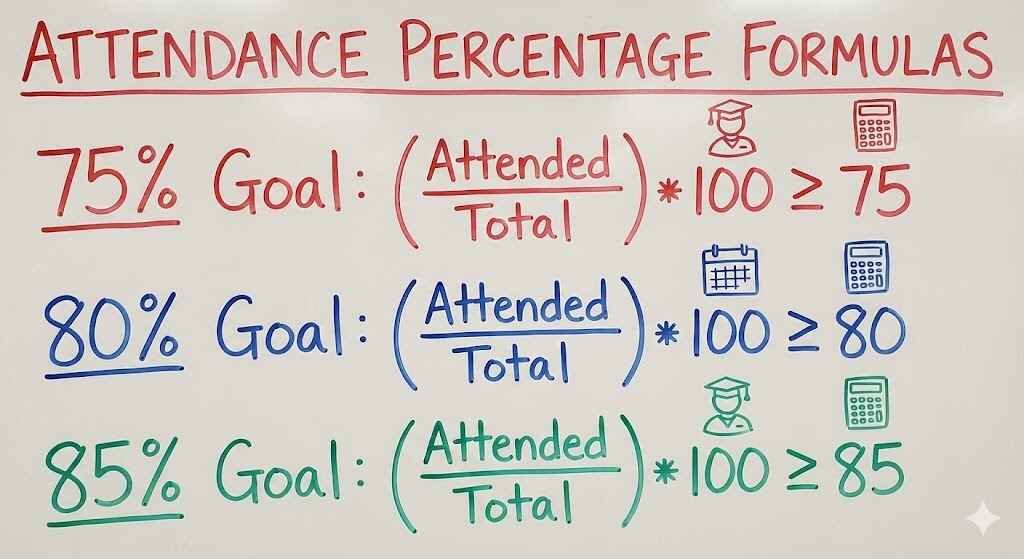
Table of Contents
Attendance Percentage Formulas for 75%, 80%, and 85%: Explained Simply
Understanding attendance formulas isn’t just about passing math class—it’s about protecting your eligibility to take exams and graduate on time. Whether your college requires 75%, 80%, or 85% attendance, the underlying mathematics remains the same, but the practical implications change dramatically.
This guide breaks down the formulas in plain language, shows you the math step-by-step, and helps you apply these calculations to real academic situations.
The Universal Attendance Formula
Every attendance calculation, regardless of the required percentage, uses the same basic formula:
Attendance Percentage = (Classes Attended ÷ Total Classes Conducted) × 100
This simple equation is the foundation of all attendance tracking. Let’s break down each component:
Classes Attended: The number of classes where you were physically present (or logged in for online courses).
Total Classes Conducted: The total number of class sessions held by the professor, whether you attended or not.
× 100: Converts the decimal result into a percentage format.
Example with Real Numbers
Let’s say your Economics professor has conducted 60 classes so far this semester, and you’ve attended 48 of them.
Attendance Percentage = (48 ÷ 60) × 100
First, divide: 48 ÷ 60 = 0.80
Then multiply by 100: 0.80 × 100 = 80%
Your attendance in Economics is 80%.
This same formula works whether you need to calculate your current percentage or determine if you meet a specific requirement.
The 75% Attendance Requirement: Most Common Standard
The 75% rule is the most widely implemented attendance policy across Indian universities and many technical institutions worldwide. Here’s how the mathematics works.
Understanding What 75% Means
When your college requires 75% attendance, it means you must be present for at least three out of every four classes. Think of it as:
- Attend 3 classes, can miss 1
- Attend 6 classes, can miss 2
- Attend 9 classes, can miss 3
The pattern is consistent: for every 4 classes, you can skip 1.
Calculating Minimum Classes Required (75%)
To find the minimum number of classes you must attend:
Minimum Attendance = Total Classes × 0.75
Let's work through several examples:
Example 1: 80 Total Classes
Minimum Attendance = 80 × 0.75 = 60 classes
You must attend at least 60 out of 80 classes.
Example 2: 100 Total Classes
Minimum Attendance = 100 × 0.75 = 75 classes
You must attend at least 75 out of 100 classes.
Example 3: 92 Total Classes
Minimum Attendance = 92 × 0.75 = 69 classes
You must attend at least 69 out of 92 classes.
Note: Always round up when you get decimals. If the calculation gives you 68.5, you need to attend 69 classes, not 68.
Calculating Maximum Absences Allowed (75%)
This is often what students really want to know—how many classes can I skip?
Maximum Absences = Total Classes × 0.25
Or alternatively:
Maximum Absences = Total Classes - (Total Classes × 0.75)
Both formulas give the same result. Use whichever feels more intuitive.
Example 1: 80 Total Classes
Maximum Absences = 80 × 0.25 = 20 classes
You can miss up to 20 classes and still meet the requirement.
Verification: 80 - 20 = 60 classes attended Percentage: (60 ÷ 80) × 100 = 75% ✓
Example 2: 120 Total Classes
Maximum Absences = 120 × 0.25 = 30 classes
You can miss up to 30 classes.
Verification: 120 - 30 = 90 classes attended Percentage: (90 ÷ 120) × 100 = 75% ✓
75% Requirement: Quick Reference Table
| Total Classes | Must Attend (75%) | Can Miss (25%) | Verification |
|---|---|---|---|
| 60 | 45 | 15 | (45÷60)×100 = 75% |
| 70 | 53 | 17 | (53÷70)×100 = 75.7% |
| 80 | 60 | 20 | (60÷80)×100 = 75% |
| 90 | 68 | 22 | (68÷90)×100 = 75.6% |
| 100 | 75 | 25 | (75÷100)×100 = 75% |
| 110 | 83 | 27 | (83÷110)×100 = 75.5% |
| 120 | 90 | 30 | (90÷120)×100 = 75% |
Notice that when the total isn't divisible by 4, you need slightly more than 75% to stay safe after rounding.
The 80% Attendance Requirement: Stricter Standard
Some institutions, particularly for professional courses like medicine, engineering labs, or honors programs, enforce an 80% attendance requirement. This significantly reduces your flexibility.
Understanding What 80% Means
An 80% requirement means you must attend 4 out of every 5 classes:
- Attend 4 classes, can miss 1
- Attend 8 classes, can miss 2
- Attend 12 classes, can miss 3
This is noticeably stricter than the 75% rule.
Calculating Minimum Classes Required (80%)
Minimum Attendance = Total Classes × 0.80
Example 1: 80 Total Classes
Minimum Attendance = 80 × 0.80 = 64 classes
You must attend at least 64 out of 80 classes.
Compare to 75% requirement: You'd only need 60 classes for 75%. The 80% requirement costs you 4 additional mandatory attendances.
Example 2: 100 Total Classes
Minimum Attendance = 100 × 0.80 = 80 classes
You must attend at least 80 out of 100 classes.
Example 3: 95 Total Classes
Minimum Attendance = 95 × 0.80 = 76 classes
You must attend at least 76 out of 95 classes.
Calculating Maximum Absences Allowed (80%)
Maximum Absences = Total Classes × 0.20
Example 1: 80 Total Classes
Maximum Absences = 80 × 0.20 = 16 classes
You can miss only 16 classes (compared to 20 with 75% requirement).
Example 2: 100 Total Classes
Maximum Absences = 100 × 0.20 = 20 classes
You can miss only 20 classes (compared to 25 with 75% requirement).
80% Requirement: Quick Reference Table
| Total Classes | Must Attend (80%) | Can Miss (20%) | Comparison to 75% |
|---|---|---|---|
| 60 | 48 | 12 | 3 fewer absences |
| 70 | 56 | 14 | 3 fewer absences |
| 80 | 64 | 16 | 4 fewer absences |
| 90 | 72 | 18 | 4 fewer absences |
| 100 | 80 | 20 | 5 fewer absences |
| 110 | 88 | 22 | 5 fewer absences |
| 120 | 96 | 24 | 6 fewer absences |
The difference between 75% and 80% might seem small mathematically, but it translates to 4-6 fewer absences you can take—often the difference between having flexibility and feeling constantly pressured to attend.
The 85% Attendance Requirement: Most Restrictive
The 85% requirement is rare but exists in certain specialized programs, medical school clinical rotations, or honors tracks. This leaves very little room for absences.
Understanding What 85% Means
An 85% requirement means you must attend 17 out of every 20 classes:
- Attend 17 classes, can miss 3
- Attend 34 classes, can miss 6
- Attend 51 classes, can miss 9
This is extremely restrictive and allows minimal flexibility for illness or emergencies.
Calculating Minimum Classes Required (85%)
Minimum Attendance = Total Classes × 0.85
Example 1: 80 Total Classes
Minimum Attendance = 80 × 0.85 = 68 classes
You must attend at least 68 out of 80 classes.
Example 2: 100 Total Classes
Minimum Attendance = 100 × 0.85 = 85 classes
You must attend at least 85 out of 100 classes.
Example 3: 120 Total Classes
Minimum Attendance = 120 × 0.85 = 102 classes
You must attend at least 102 out of 120 classes.
Calculating Maximum Absences Allowed (85%)
Maximum Absences = Total Classes × 0.15
Example 1: 80 Total Classes
Maximum Absences = 80 × 0.15 = 12 classes
You can miss only 12 classes.
Example 2: 100 Total Classes
Maximum Absences = 100 × 0.15 = 15 classes
You can miss only 15 classes.
85% Requirement: Quick Reference Table
| Total Classes | Must Attend (85%) | Can Miss (15%) | Comparison to 75% |
|---|---|---|---|
| 60 | 51 | 9 | 6 fewer absences |
| 70 | 60 | 10 | 7 fewer absences |
| 80 | 68 | 12 | 8 fewer absences |
| 90 | 77 | 13 | 9 fewer absences |
| 100 | 85 | 15 | 10 fewer absences |
| 110 | 94 | 16 | 11 fewer absences |
| 120 | 102 | 18 | 12 fewer absences |
With an 85% requirement, you lose 10-12 permissible absences compared to a 75% requirement—a substantial difference that demands nearly perfect attendance.
Side-by-Side Comparison: 75% vs 80% vs 85%
Let's compare all three requirements directly to understand the practical impact:
For 80 Total Classes
| Requirement | Must Attend | Can Miss | Your Flexibility |
|---|---|---|---|
| 75% | 60 | 20 | Can miss 1 in 4 |
| 80% | 64 | 16 | Can miss 1 in 5 |
| 85% | 68 | 12 | Can miss 3 in 20 |
For 100 Total Classes
| Requirement | Must Attend | Can Miss | Your Flexibility |
|---|---|---|---|
| 75% | 75 | 25 | Can miss 1 in 4 |
| 80% | 80 | 20 | Can miss 1 in 5 |
| 85% | 85 | 15 | Can miss 3 in 20 |
For 120 Total Classes
| Requirement | Must Attend | Can Miss | Your Flexibility |
|---|---|---|---|
| 75% | 90 | 30 | Can miss 1 in 4 |
| 80% | 96 | 24 | Can miss 1 in 5 |
| 85% | 102 | 18 | Can miss 3 in 20 |
The difference becomes more pronounced as the semester progresses and total classes increase.
Reverse Calculation: How Many More Must You Attend?
Sometimes you need to work backwards: "I have X% attendance now. How many more classes must I attend to reach the required percentage?"
This requires a more complex formula:
Classes Needed = [(Required % × Total Classes) - Classes Already Attended] ÷ (1 - Required %)
Let's simplify this with a real scenario.
Real-World Example: Catching Up to 75%
Situation: Chemistry has conducted 50 classes. You've attended only 30 (60% attendance). The semester will have 80 total classes. How many of the remaining 30 classes must you attend to reach 75%?
Step 1: Calculate minimum needed for 75% 80 × 0.75 = 60 classes total needed
Step 2: Calculate how many more you need 60 - 30 = 30 more classes needed
Step 3: Calculate remaining classes 80 - 50 = 30 classes remaining
Conclusion: You must attend ALL 30 remaining classes. Missing even one will drop you below 75%.
Final check: (30 + 30) ÷ 80 = 60 ÷ 80 = 75% ✓
Real-World Example: Catching Up to 80%
Situation: Same scenario but with 80% requirement.
Step 1: Calculate minimum needed for 80% 80 × 0.80 = 64 classes total needed
Step 2: Calculate how many more you need 64 - 30 = 34 more classes needed
Step 3: Calculate remaining classes 80 - 50 = 30 classes remaining
Conclusion: This is impossible! You need 34 more classes but only 30 remain. You cannot reach 80% attendance anymore.
This illustrates how much stricter the 80% requirement is—situations recoverable under 75% become impossible under 80%.
Calculating Your Safety Buffer
Smart students don't aim for exactly 75%, 80%, or 85%—they build in a safety buffer. Here's how to calculate your comfortable target:
Safe Target = Required % + 5%
For 75% requirement: Aim for 80% For 80% requirement: Aim for 85% For 85% requirement: Aim for 90%
This 5% buffer protects you against:
- Disputed attendance marks
- Sudden illness or emergencies
- Calculation discrepancies
- Classes you forgot about
Buffer Calculation Example
Scenario: 100 total classes, 75% required
Minimum needed: 100 × 0.75 = 75 classes Safe target: 100 × 0.80 = 80 classes Your buffer: 5 classes for emergencies
If you maintain 80% attendance, you have 5 "emergency absences" available while still staying above 75%.
Predictive Calculation: Future Percentage Scenarios
Want to know what your final percentage will be if you attend all remaining classes? Or what if you miss a certain number? Here's the formula:
Future % = [(Current Attendance + Future Attendance) ÷ Total Classes] × 100
Scenario 1: Attending All Remaining Classes
Current situation:
- 60 classes held
- 40 attended (66.7% current)
- 100 total expected
- 40 classes remaining
If you attend all 40 remaining: Future % = [(40 + 40) ÷ 100] × 100 = 80%
Good news! You can recover to 80% by attending everything from now on.
Scenario 2: Strategic Absence Planning
Current situation:
- 60 classes held
- 50 attended (83.3% current)
- 100 total expected
- 40 classes remaining
If you miss 5 of the remaining 40: Future Attendance = 50 + (40 - 5) = 50 + 35 = 85 Future % = (85 ÷ 100) × 100 = 85%
You can afford to miss 5 more classes and still finish comfortably above 75%.
Scenario 3: Maximum Absences Planning
Question: How many more classes can I miss and still hit exactly 75%?
Formula: Maximum Future Absences = (Remaining Classes) - [(Total × 0.75) - Current Attendance]
Using the scenario above: Maximum Future Absences = 40 - [(100 × 0.75) - 50] = 40 - [75 - 50] = 40 - 25 = 15 classes
You can miss up to 15 of the remaining 40 classes and still reach exactly 75%.
Verification: 50 + (40 - 15) = 50 + 25 = 75 Percentage: (75 ÷ 100) × 100 = 75% ✓
Handling Partial or Decimal Results
Real-world calculations often produce decimals. Here's how to handle them correctly:
When Calculating Classes to Attend
Always round UP to be safe.
Example: 92 total classes, 75% required 92 × 0.75 = 69 classes
You must attend at least 69 classes (already a whole number).
Example: 95 total classes, 75% required 95 × 0.75 = 71.25 classes
Round up to 72 classes to guarantee you meet the requirement.
Why round up? Because attending 71 classes gives you: (71 ÷ 95) × 100 = 74.74% — below 75%!
But attending 72 classes gives you: (72 ÷ 95) × 100 = 75.79% — above 75% ✓
When Calculating Classes You Can Miss
Always round DOWN to be safe.
Example: 95 total classes, can miss 25% 95 × 0.25 = 23.75 classes
Round down to 23 classes maximum absences.
Why round down? Because missing 24 classes means attending 71: (71 ÷ 95) × 100 = 74.74% — below 75%!
But missing 23 classes means attending 72: (72 ÷ 95) × 100 = 75.79% — above 75% ✓
Safe Rounding Rule
When it benefits you (calculating absences): Round down When it protects you (calculating attendance): Round up
This conservative approach ensures you never accidentally fall below the threshold due to rounding errors.
Real Academic Scenarios: Applying the Formulas
Let's work through complete real-world situations students face:
Scenario 1: Mid-Semester Check
Student Profile: Raj, Computer Science, 75% requirement
Current Status:
- Data Structures: 45 classes held, 38 attended
- Operating Systems: 42 classes held, 35 attended
- Mathematics: 40 classes held, 28 attended
Calculations:
Data Structures: (38 ÷ 45) × 100 = 84.4% ✓ Safe Operating Systems: (35 ÷ 42) × 100 = 83.3% ✓ Safe Mathematics: (28 ÷ 40) × 100 = 70% ✗ Danger!
Action Plan for Mathematics: Expected total classes: 80 Minimum needed: 80 × 0.75 = 60 classes Already attended: 28 Still need: 60 - 28 = 32 more classes Remaining classes: 80 - 40 = 40
Can miss: 40 - 32 = 8 more classes maximum
Advice: Raj must attend at least 32 of the next 40 Mathematics classes. He should aim for 35+ to build a safety buffer.
Scenario 2: Medical Leave Recovery
Student Profile: Priya, Mechanical Engineering, 80% requirement
Situation: Priya was hospitalized for 2 weeks, missing 10 classes in Thermodynamics.
Before hospitalization:
- 30 classes held, 30 attended (100%)
After hospitalization:
- 40 classes held, 30 attended
- Current: (30 ÷ 40) × 100 = 75%
Problem: She has 75% but needs 80%. Can she recover?
Calculation: Expected total: 80 classes Minimum for 80%: 80 × 0.80 = 64 classes Already attended: 30 Still need: 64 - 30 = 34 classes Remaining: 80 - 40 = 40 classes
Can miss: 40 - 34 = 6 more classes
Conclusion: Yes, she can recover! If she attends 34 of the remaining 40 classes: (30 + 34) ÷ 80 = 64 ÷ 80 = 80% ✓
Advice: Priya should apply for medical concession for those 10 classes. If approved, they won't count against her total, improving her percentage significantly.
Scenario 3: Multiple Subject Management
Student Profile: Ahmed, Business Administration, 75% requirement
Current Status (50 classes held in each subject):
| Subject | Attended | Current % | Status |
|---|---|---|---|
| Marketing | 45 | 90% | Excellent |
| Finance | 40 | 80% | Good |
| Economics | 38 | 76% | Marginal |
| Statistics | 35 | 70% | Danger |
Expected total per subject: 90 classes
Analysis:
Marketing: Can afford to miss (90 × 0.25) - (50 - 45) = 22.5 - 5 = 17 more classes
Finance: Can afford to miss (90 × 0.25) - (50 - 40) = 22.5 - 10 = 12 more classes
Economics: Can afford to miss (90 × 0.25) - (50 - 38) = 22.5 - 12 = 10 more classes
Statistics: Must attend at least (90 × 0.75) - 35 = 67.5 - 35 = 33 of the remaining 40 classes
Strategy: Ahmed has good cushion in Marketing and Finance. He should focus attention on Statistics, missing no more than 7 of its remaining classes, while maintaining regular attendance in Economics.
Mistakes to Avoid
Mistake 1: Mixing up current and required percentages
Wrong thinking: "I have 70% attendance. I need 75%. So I need 5% more."
This doesn't work because percentages are relative to changing totals.
Correct approach: Calculate exactly how many classes you need based on total expected classes, not percentage points.
Mistake 2: Forgetting to account for future classes
Wrong calculation: "60 classes held, I attended 50. That's 83%. I'm safe!"
Problem: If 100 classes total are expected, you can still drop below 75% if you miss too many of the remaining 40.
Correct approach: Always consider the full semester projection, not just current status.
Mistake 3: Rounding incorrectly
Wrong: 95 × 0.75 = 71.25, so I need 71 classes. Result: (71 ÷ 95) × 100 = 74.74% — Failed!
Correct: Always round UP for required attendance. You need 72 classes: (72 ÷ 95) × 100 = 75.79% — Passed!
Mistake 4: Ignoring subject-wise calculation
Wrong thinking: "My overall attendance across all subjects is 78%, so I'm fine."
Problem: Requirements apply to EACH subject individually. You might have 90% in three subjects and 60% in one—you'll fail that one subject's exam.
Correct approach: Calculate and track each subject separately.
Quick Mental Math Shortcuts
For fast calculations without a calculator:
For 75% requirement (3 out of 4): Divide total classes by 4 = maximum absences
80 classes ÷ 4 = 20 absences allowed 100 classes ÷ 4 = 25 absences allowed
For 80% requirement (4 out of 5): Divide total classes by 5 = maximum absences
80 classes ÷ 5 = 16 absences allowed 100 classes ÷ 5 = 20 absences allowed
For 85% requirement (approximately 6 out of 7): Divide total classes by 7 = approximate maximum absences
84 classes ÷ 7 = 12 absences allowed (approximately) 98 classes ÷ 7 = 14 absences allowed (approximately)
These shortcuts give you quick estimates. For final decisions, always use the precise formulas.
Key Takeaways
Understanding attendance percentage formulas empowers you to make informed decisions about class attendance:
- Universal formula: Attendance % = (Classes Attended ÷ Total Classes) × 100 works for all requirements
- 75% requirement: Must attend 3 out of every 4 classes; can miss 25% of total
- 80% requirement: Must attend 4 out of every 5 classes; can miss only 20% of total
- 85% requirement: Must attend 17 out of every 20 classes; can miss only 15% of total
- Safety buffers: Always aim 5% higher than the minimum to protect against emergencies
- Rounding rules: Round UP when calculating required attendance; round DOWN when calculating permissible absences
- Subject-wise tracking: Requirements apply to each course individually, not overall average
- Forward planning: Calculate how many remaining classes you must attend to meet requirements
- Recovery is possible: Early semester shortfalls can often be recovered with perfect attendance later
The mathematics of attendance isn't complicated, but the consequences of miscalculation are serious. Use these formulas to track your attendance accurately, plan absences strategically, and ensure you never face exam ineligibility due to attendance shortages.
Calculate carefully, attend consistently, and protect your academic future.
Attendance changes every week.
Recalculate whenever a new class is added.