
CBSE Attendance Requirements: What Class 10 & 12 Students Must Know
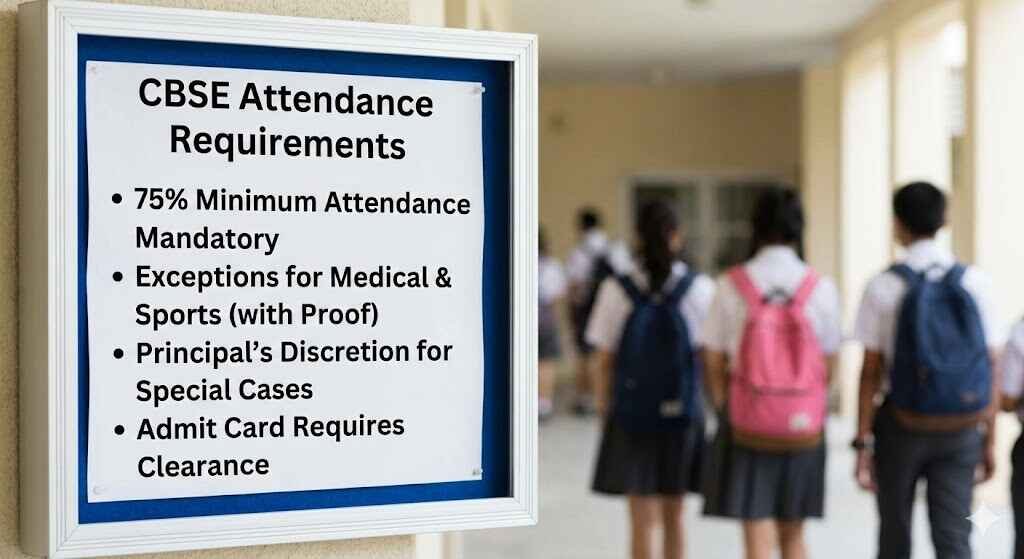
Table of Contents
CBSE Attendance Requirements Guide
For students appearing in board examinations, few things cause as much last-minute panic as attendance shortfalls. If you’re in Class 10 or Class 12 under the Central Board of Secondary Education (CBSE), understanding attendance requirements isn’t optional—it’s essential for your exam eligibility.
Unlike college where some flexibility exists, board class attendance rules carry serious consequences. Missing the minimum threshold can prevent you from sitting for your board exams, potentially delaying your academic progress by an entire year.
Let’s break down exactly what CBSE expects, how the system works, and what you need to do to stay on track.
Calculate Your Attendance Here
Official CBSE Attendance Policy for Board Classes
The CBSE has clear directives regarding attendance for students in Classes 10 and 12. These guidelines are outlined in the board’s examination bylaws and circulars issued to affiliated schools.
The fundamental requirement: Students must maintain a minimum of 75% attendance in each subject to be eligible for the board examinations.
This means if your school conducts 200 working days in an academic year, you need to attend at least 150 days. The calculation applies to the entire academic session, not just a single term or semester.
Important distinction: This is school attendance, not just attendance for a particular subject. CBSE calculates attendance based on the number of school working days you attend, not class-by-class tracking like in universities.
However, individual schools may maintain subject-wise attendance records as part of their internal assessment and discipline policies.
How CBSE Attendance Is Calculated
Understanding the calculation method helps you track your standing throughout the year.
The formula is straightforward:
Attendance Percentage = (Days Attended ÷ Total Working Days) × 100
For example, if your school has 220 working days and you attended 180 of them:
(180 ÷ 220) × 100 = 81.82%
In this case, you’ve comfortably met the 75% requirement.
What counts as a “working day”?
Working days include all days when regular classes are scheduled, excluding:
- Sundays and gazetted holidays
- School-declared holidays
- Days when school is closed due to unforeseen circumstances (natural disasters, strikes, etc.)
- Authorized school events where regular classes don’t occur
Days when you’re present for even a partial schedule typically count as full attendance, though policies may vary by school.
Subject-Specific Attendance Requirements
While the primary requirement is 75% overall school attendance, CBSE also emphasizes the importance of subject-specific presence, particularly for practical subjects.
For practical subjects (Science, Computer Science, Physical Education, etc.):
Students must complete all mandatory practical work and internal assessments. Simply attending school isn’t enough if you miss practical classes consistently.
Schools maintain separate practical attendance registers, and insufficient practical attendance can result in incomplete internal assessment, which affects your board exam eligibility.
For theory subjects:
While individual class attendance may not be tracked as strictly, consistent absence from specific subjects creates learning gaps that impact board exam performance. Many schools implement their own subject-wise tracking as part of academic monitoring.
Important note: Even if you meet the 75% overall attendance, your school can refuse to register you for board exams if you haven’t completed mandatory practical work or internal assessments.
Condonation of Attendance: When and How It Works
CBSE recognizes that genuine circumstances sometimes prevent regular attendance. The board has provisions for attendance condonation, but these are strictly regulated.
Who Can Apply for Condonation?
Students who fall short of the 75% attendance requirement due to valid, documented reasons may apply for condonation through their school principal.
Valid Grounds for Condonation
CBSE typically considers the following circumstances:
Medical reasons: Prolonged illness, hospitalization, surgery, or chronic health conditions that required extended absence.
Family emergencies: Serious illness or death of immediate family members (parents, siblings).
Participation in official events: Representing the school, district, state, or nation in sports, cultural activities, or academic competitions.
Natural disasters: Situations beyond personal control like floods, earthquakes, or pandemics affecting the student’s ability to attend school.
Accidents or injuries: Physical injuries requiring recovery time with proper medical documentation.
Relocation mid-session: Students who transferred from another board or school mid-year due to parental job transfer or other unavoidable circumstances.
What Condonation Does NOT Cover
CBSE and schools typically reject condonation requests for:
- Casual absence without documented reasons
- Tuition classes or private coaching that conflicted with school timings
- Personal travel or vacations
- Minor illnesses that didn’t require extended absence
- Poor time management or oversleeping
- Preparation for competitive exams
Don’t assume that having a reason automatically grants condonation. The circumstances must be genuinely exceptional and properly documented.
The Condonation Application Process
If you find yourself below the 75% threshold with valid reasons, here’s how to apply for attendance condonation:
Step 1: Gather Documentation
Collect comprehensive proof of your circumstances:
For medical reasons:
- Doctor’s certificates with registration numbers
- Hospital admission records and discharge summaries
- Medical prescriptions and test reports
- Specialist recommendations if applicable
For family emergencies:
- Death certificates (if applicable)
- Hospital records of family member
- Official documentation supporting the emergency
For official participation:
- Invitation letters or selection certificates
- Participation certificates from organizing bodies
- Letters from school authorities approving participation
Step 2: Write a Formal Application
Address your application to the school principal. Include:
- Your name, class, section, and admission number
- Exact attendance percentage
- Detailed explanation of circumstances causing absence
- Period of absence with specific dates
- Request for attendance condonation
- List of attached supporting documents
Keep the tone respectful and factual. Emotional appeals without documentation rarely succeed.
Step 3: Submit Through Proper Channels
Submit your application well before the board exam registration deadline—typically by September/October for the February/March board exams.
Schools have internal committees that review condonation requests. This process takes time, so don’t wait until the last moment.
Step 4: School Principal’s Recommendation
The school principal reviews your application and supporting documents. If satisfied with the genuineness of your case, the principal submits a recommendation to the CBSE regional office.
Critical point: The principal has significant discretion here. A strong recommendation greatly improves your chances of approval.
Step 5: CBSE Review and Decision
The CBSE regional office reviews the principal’s recommendation and makes the final decision. Approval is not automatic—each case is evaluated individually.
If approved, CBSE issues condonation, allowing the school to register you for board examinations despite the attendance shortfall.
Medical Certificate Requirements
Medical certificates are the most common supporting documents for attendance condonation. CBSE has specific requirements for these certificates to be considered valid.
Essential elements of a valid medical certificate:
- Issued on doctor’s official letterhead
- Doctor’s name with qualification and registration number
- Hospital or clinic stamp
- Patient’s name and age
- Specific dates of illness and treatment
- Nature of ailment (general description—not necessarily detailed diagnosis)
- Recommendation for rest/absence from school with specific duration
- Doctor’s signature and date
- Contact information of medical practitioner
What makes a medical certificate suspicious:
- Generic certificates without specific dates
- Certificates from unlicensed practitioners
- Backdated certificates (dates added after the fact)
- Certificates covering extended periods issued in a single visit
- Missing registration numbers or verifiable doctor information
- Certificates from family members who are doctors (conflict of interest)
Schools and CBSE may verify medical certificates with the issuing doctor or hospital. Submitting fake or fraudulent certificates can result in severe penalties, including cancellation of your board exam registration.
Attendance Tracking: Student Responsibilities
While schools maintain official attendance registers, you shouldn’t rely solely on school records. Taking personal responsibility for tracking your attendance prevents surprises.
Maintain Your Own Record
Create a simple attendance diary or spreadsheet:
- Mark each school day as present or absent
- Note reasons for any absence
- Keep a running total of days attended vs. total working days
- Calculate your percentage weekly
This personal record helps you identify problems early and provides a reference if discrepancies arise in school records.
Check School Records Regularly
Most schools display monthly attendance or provide reports to parents. Review these carefully:
- Verify that your presence is recorded accurately
- Report discrepancies immediately to your class teacher
- Get corrections made in official registers promptly
Don’t wait until exam registration time to discover attendance errors. By then, making corrections becomes difficult or impossible.
Understand Your School’s System
Different schools use different attendance systems:
- Manual registers marked by teachers
- Biometric systems requiring fingerprint or card scanning
- Digital apps where teachers mark attendance electronically
- Hybrid systems combining manual and digital methods
Know how your school tracks attendance. If it’s biometric, ensure you scan in every day. If it’s manual roll call, respond clearly when your name is called.
Keep Communication Open
If you must miss school for valid reasons:
- Inform your class teacher or school office in advance when possible
- Provide written intimation from parents
- Submit required documents (medical certificates, etc.) as soon as you return
- Follow up to ensure your absence is recorded as excused rather than unexplained
Proactive communication demonstrates responsibility and makes condonation applications stronger if needed later.
Common Attendance Mistakes Students Make
Learning from others’ mistakes helps you avoid similar pitfalls.
Mistake 1: Assuming 75% Is a Target
Many students think, “I need 75%, so I’ll aim for exactly that.” This is dangerous. Life is unpredictable—you might fall ill, face family emergencies, or encounter unexpected situations.
Better approach: Aim for 85-90% attendance. This buffer protects you against unforeseen absences.
Mistake 2: Bunking in Groups
Peer pressure leads many students to skip school together, especially after major exams when “nothing important” seems to be happening.
Remember: Your friends might have attendance buffer; you might not. Every absence chips away at your margin of safety.
Mistake 3: Prioritizing Coaching Over School
Some students skip school to attend coaching classes for competitive exams like JEE or NEET.
Reality check: Board exam eligibility comes first. Without it, competitive exam scores are meaningless for college admission. Most colleges require board exam mark sheets, and CBSE won’t issue one if you’re ineligible due to attendance.
Mistake 4: Ignoring Early Warning Signs
If you’re at 78-79% attendance by mid-session, you’re in the danger zone. Many students ignore this, thinking they’ll “make it up later.”
The math works against you: As the year progresses, improving your percentage becomes increasingly difficult. If you’ve missed 40 days out of 180, attending the next 20 days only marginally improves your percentage.
Mistake 5: Submitting Fake Documents
Desperation leads some students to submit forged medical certificates or fabricated documents.
Consequences are severe: If caught, you face exam cancellation, school disciplinary action, and potential legal issues. It’s simply not worth the risk.
Mistake 6: Waiting Until Registration Time
Many students only check their attendance when board exam registration begins (typically August-October).
Problem: By then, you’ve lost most of the academic year. If you’re below 75%, your options are limited—you either need condonation (which isn’t guaranteed) or you cannot appear for boards.
Solution: Check your attendance monthly, not annually.
Special Considerations for Class 12 Students
Class 12 carries additional pressure because board results directly affect college admissions, scholarship opportunities, and career paths.
Internal Assessment Impact
Class 12 students have internal assessment components (practicals, projects, assignments) that contribute to final board marks. Irregular attendance can result in:
- Incomplete practical work
- Missed project deadlines
- Insufficient continuous evaluation
- Lower internal assessment marks
Even if you’re allowed to sit for board exams through attendance condonation, poor internal assessment significantly impacts your final percentage.
Practical Examination Requirements
For science students, practical exams are conducted by external examiners appointed by CBSE. You cannot appear for these practicals if you haven’t completed mandatory practical work throughout the year.
No amount of attendance condonation exempts you from completing the practical syllabus. This requires regular presence in laboratory sessions.
College Application Deadlines
College admissions often begin immediately after board results. Any delay in receiving your mark sheet (due to attendance issues or re-examination) can cause you to miss college application deadlines.
The competitive college admission process has no sympathy for attendance-related delays. Secure your eligibility first.
Special Considerations for Class 10 Students
While Class 10 boards are important, the stakes differ slightly from Class 12.
Foundation for Class 11-12
Class 10 attendance habits set patterns for senior secondary. Students who barely scrape through with 75% in Class 10 often face bigger attendance problems in Classes 11 and 12.
Develop good habits now: Regular attendance in Class 10 establishes discipline that serves you well in board years.
Stream Selection Implications
Some schools consider Class 10 attendance when approving stream selection (Science, Commerce, Arts) for Class 11. Erratic attendance might affect your ability to get your preferred stream.
Scholarship and Recognition
Many state governments and organizations offer scholarships and recognition for Class 10 board toppers. Attendance is sometimes a criterion for eligibility in these programs.
What Happens If You Don’t Meet Attendance Requirements?
Understanding the consequences helps you appreciate the importance of maintaining attendance.
Scenario 1: Attendance Below 75% Without Condonation Approval
If your attendance is below 75% and your condonation request is either not submitted or rejected:
- The school cannot register you for CBSE board examinations
- You cannot appear for board exams that year
- You must repeat Class 10 or 12 the following academic year
- Your academic progression is delayed by one full year
This is not a situation where you can appeal directly to CBSE. The decision lies with the school principal and CBSE regional office based on their review of your case.
Scenario 2: Attendance Meets Overall Requirement But Practicals Are Incomplete
If you have 75% attendance but haven’t completed mandatory practical work or internal assessments:
- You may be eligible to appear for theory papers
- You cannot appear for practical examinations
- Your result will be declared incomplete or “XXXX” in subjects with incomplete practicals
- You’ll need to complete practicals and appear for compartment/improvement exams later
This delay in receiving a complete mark sheet affects college admissions significantly.
Scenario 3: Discrepancies Discovered After Registration
If attendance discrepancies or fraudulent documentation are discovered after board exam registration:
- CBSE can cancel your registration
- If discovered after exams, your results may be withheld or cancelled
- The school may face penalties from CBSE for incorrect registration
- You may face disciplinary action or legal consequences for document fraud
Schools’ Role and Responsibilities
Understanding what schools are required to do helps you hold them accountable.
Regular Attendance Communication
Schools should:
- Maintain accurate daily attendance registers
- Provide monthly attendance reports to students and parents
- Issue warnings when attendance falls below acceptable levels
- Communicate clearly about attendance requirements at the beginning of the academic year
If your school isn’t providing regular attendance updates, request them proactively from your class teacher or administrative office.
Fair and Transparent Systems
CBSE requires schools to:
- Maintain attendance registers that are verifiable and auditable
- Treat all students equally in attendance marking
- Provide opportunities for students to verify their attendance records
- Have clear policies for marking absent, late arrivals, and partial attendance
If you believe attendance is being marked unfairly or discriminatorily, you can approach the school principal or, if necessary, the CBSE regional office.
Timely Processing of Condonation Requests
Schools must:
- Accept condonation applications with reasonable time
- Process them promptly through internal committees
- Forward approved cases to CBSE within stipulated deadlines
- Communicate decisions to students and parents clearly
Administrative delays by schools shouldn’t jeopardize your exam eligibility if you’ve submitted a valid application on time.
Practical Tips for Maintaining Good Attendance
Prevention is always better than seeking condonation. Here are actionable strategies:
Establish a Routine
- Set consistent sleep and wake times, even on weekends
- Prepare school bag and uniform the night before
- Have a morning checklist to avoid last-minute rushes
- Use multiple alarms if you struggle with waking up
Prioritize Health
- Maintain proper nutrition and hydration
- Get adequate sleep (8-9 hours for teenagers)
- Exercise regularly to build immunity
- Practice good hygiene to prevent common illnesses
- Get vaccinations and preventive care
Plan Ahead
- If you have a medical appointment, try to schedule it after school hours
- For unavoidable absences (family functions, etc.), inform school in advance
- Complete any missed work promptly to stay on track academically
- Keep emergency buffer by maintaining higher than minimum attendance
Stay Motivated
- Remember your long-term academic goals
- Focus on the learning opportunities in each class
- Build positive relationships with teachers and classmates
- Participate actively in school activities to feel connected
Involve Parents
- Keep parents informed about your attendance status
- Ask them to help you maintain discipline and routine
- Ensure they understand CBSE attendance requirements
- Have them follow up with school if attendance issues arise
Key Takeaways
CBSE attendance requirements for Classes 10 and 12 are non-negotiable aspects of board exam eligibility. Here’s what you must remember:
- 75% minimum attendance is mandatory for appearing in CBSE board examinations
- Track your own attendance monthly—don’t rely solely on school records
- Aim for 85-90% to create a safety buffer for unexpected absences
- Document all absences with proper certificates and intimation letters
- Complete practical work regardless of overall attendance percentage
- Apply for condonation early if circumstances prevent adequate attendance—don’t wait until registration time
- Submit genuine documents only—fraudulent certificates have severe consequences
- Communicate proactively with teachers and school administration about attendance concerns
Board classes are critical stepping stones in your academic journey. While 75% might seem like a manageable threshold, treating it as a target rather than a minimum is risky. Regular attendance isn’t just about meeting eligibility criteria—it’s about giving yourself the best chance to understand concepts, prepare effectively, and perform well in board examinations.
Your attendance record is entirely within your control. Make conscious, responsible choices every day, and you’ll never face the stress of last-minute condonation applications or, worse, exam ineligibility.
Start tracking today, maintain consistency throughout the year, and approach your board exams with confidence—knowing that you’ve secured your eligibility through responsible attendance management.