
Table of Contents
How Many Classes Can I Miss for 85% Attendance? Explained
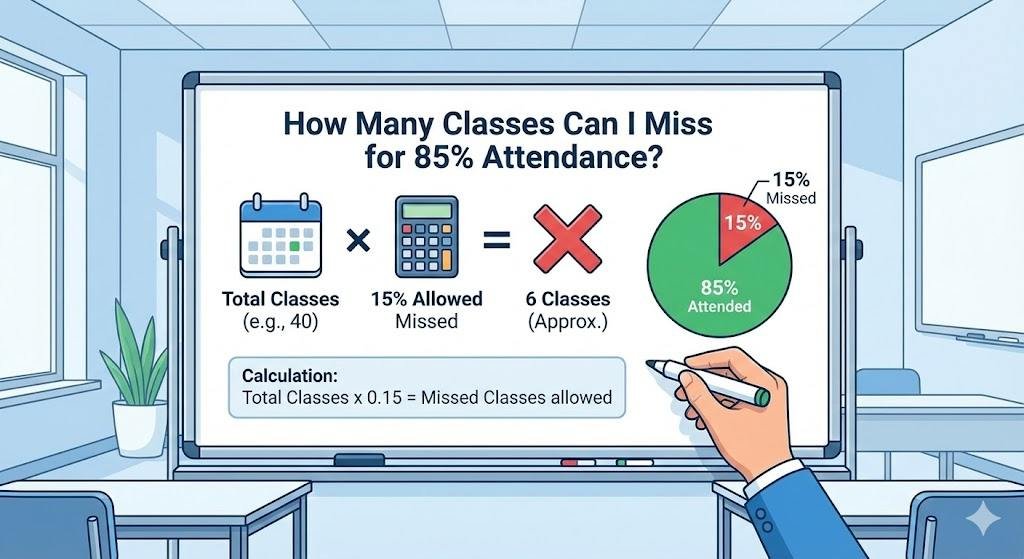
The 85% attendance requirement means you must attend at least 85 out of every 100 classes conducted during a semester. This is stricter than the common 75% rule and is typically enforced in professional programs, competitive courses, or institutions with rigorous academic standards.
Colleges use 85% attendance instead of 75% to ensure students maintain consistent engagement with course material. The higher threshold reduces the number of permitted absences and encourages regular class participation, which is particularly important for subjects requiring continuous skill development or cumulative learning.
Enforcement of the 85% attendance rule varies by institution. Some colleges strictly bar students from exams if they fall below this threshold, while others may impose grade penalties or require additional assignments. Students should consult their academic handbook or course syllabus to understand how their specific institution applies this requirement.
Allowed Absences Under 85% Rule
The formula for calculating allowed absences under the 85% attendance rule is straightforward:
Allowed Absences = Total Classes × 0.15
Or written another way:
Allowed Absences = Total Classes × (1 − 0.85)
This calculation tells you the maximum number of classes you can miss while still maintaining exactly 85% attendance.
Important note on rounding: Most institutions round down (floor function), not up. If the calculation gives you 8.5 absences, you can safely miss only 8 classes, not 9. Missing that 9th class would push you below the 85% threshold.
In practical terms, the 85% rule means you can miss roughly 3 classes out of every 20 conducted, or about 15 classes per 100. This leaves limited room for emergencies, illness, or personal commitments, so planning your absences carefully is essential.
85% Attendance Bunk Planner Examples
| Total Classes | Required Attendance (85%) | Classes You Can Miss | Your Attendance if You Miss All Allowed |
|---|---|---|---|
| 40 | 34 | 6 | 85.0% |
| 60 | 51 | 9 | 85.0% |
| 80 | 68 | 12 | 85.0% |
| 100 | 85 | 15 | 85.0% |
| 120 | 102 | 18 | 85.0% |
Example 1 breakdown: If your course conducts 40 classes total by semester end, you must attend at least 34 classes. This means you can afford to miss 6 classes maximum. Using all 6 absences puts you exactly at 85%, leaving no buffer for unexpected situations.
Example 2 breakdown: With 60 total classes, the calculation is 60 × 0.15 = 9 allowed absences. You need to attend 51 out of 60 classes. Missing your 10th class drops you to 83.3% attendance, which falls below the requirement and may affect your exam eligibility.
Example 3 breakdown: For an 80-class semester, you can miss 12 classes while maintaining 85% attendance. However, if you’ve already missed 10 classes by mid-semester and 20 more classes are scheduled, you can only afford to miss 2 additional classes for the rest of the term.
Real scenario: Consider a typical engineering semester where each subject has approximately 50 lectures. With 85% requirement, you can miss 7-8 lectures per subject. If you’re enrolled in 6 subjects, that’s roughly 42-48 total absences across all courses for the entire semester. This might sound like a lot, but distributed across 4 months, it’s about 10-12 absences per month total, or 2-3 per week across all subjects combined.
Month-by-Month Absence Guide for 85% Attendance
| Semester Progress | Typical Classes Held | Cumulative Absences Used | Remaining Buffer |
|---|---|---|---|
| Month 1 | 20 per subject | 3 | Safe zone |
| Month 2 | 40 per subject | 6 | Comfortable |
| Month 3 | 60 per subject | 9 | Getting tight |
| Month 4 | 80 per subject | 12 | No room left |
This table shows a single subject with 80 total classes. Notice how your buffer disappears as the semester progresses. Students who use all their absences early face problems if they get sick or have emergencies later.
Is 85% Attendance Strictly Enforced?
Enforcement of the 85% attendance rule depends entirely on institutional policy and departmental discretion. Some colleges automatically deny exam hall tickets to students below 85%, while others review cases individually and may grant exceptions for documented medical emergencies or official college activities.
Lab attendance often has separate and stricter requirements than lecture attendance. Many institutions require 90-100% attendance for laboratory sessions regardless of the 85% lecture requirement, since labs involve hands-on skills, equipment usage, and safety protocols that cannot be replicated through makeup work.
Medical leave and official duties may be treated differently. Some colleges deduct medical absences from your total, effectively not counting them against your attendance. Others count all absences the same way but may grant special consideration during eligibility reviews. University-sanctioned activities like sports tournaments, cultural events, or academic competitions may be marked as “duty leave” rather than absences.
Students should always verify attendance policies with their specific department or academic office. Don’t rely on assumptions or what worked for seniors in previous years, as policies can change. The attendance rules printed in your course handbook or mentioned in your first-week orientation are the authoritative source for your program.
FAQs About 85% Attendance
Can I miss labs under 85% attendance?
Lab attendance typically requires 90-100% presence regardless of the 85% lecture rule. Labs involve practical skills, safety training, and group activities that cannot be made up easily. Check your lab manual for specific requirements, but assume you must attend all scheduled lab sessions.
What happens if I drop below 85%?
Consequences vary by institution but commonly include: denial of exam eligibility, reduction in internal assessment marks, academic warning notices, or requirement to repeat the course. Some colleges have appeal processes for students who drop below due to documented emergencies or medical reasons.
Does attendance change if total classes increase?
Yes. If your professor schedules additional classes mid-semester, the total class count increases, which changes your allowed absences. For example, if 10 extra classes are added and you’ve already used your absence quota, you must attend all remaining classes to maintain 85%. Always recalculate when the schedule changes.
Is 85% required every semester?
Most colleges calculate attendance separately for each semester or term. Your attendance percentage typically resets at the beginning of each new academic period. Year-long courses may calculate attendance across both semesters, but this is less common. Check whether your courses are semester-based or year-long.
Does medical leave count toward attendance?
This varies significantly between institutions. Some colleges exclude documented medical absences from attendance calculations if you submit proper medical certificates within specified timeframes. Others count all absences equally but may grant special consideration during eligibility reviews. Submit medical documentation to your department office promptly and follow their specific procedures.
What if I’m at exactly 85%?
Being precisely at 85% is risky. Any attendance marking error, one additional absence, or rounding down by the system can push you below the threshold. Aim to maintain 87-88% as a safety buffer. This gives you room for emergencies, administrative errors, or unexpected circumstances without jeopardizing your eligibility.
Disclaimer: This information is based on commonly followed academic attendance rules. Final eligibility depends on institutional policies. Always verify attendance requirements through your college’s official academic handbook and departmental notifications.